

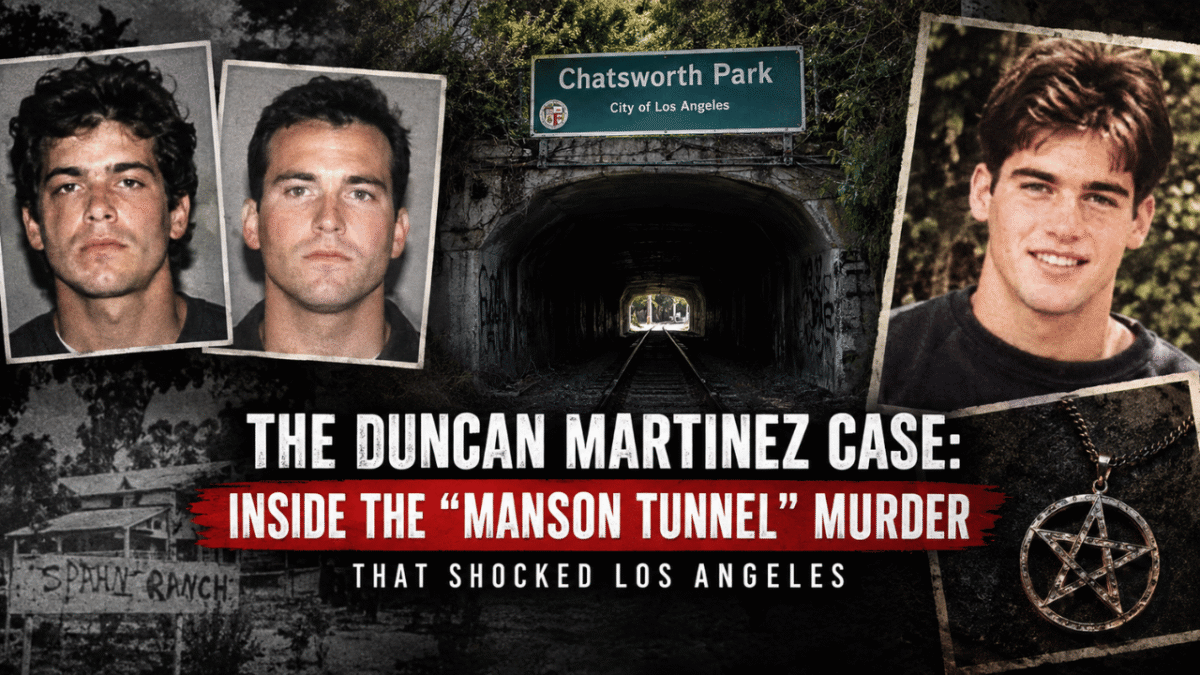
Matthew Martinez was fascinated by beautiful women. The investigation into a missing-person report filed by a concerned family in the summer of 1990 eventually revealed a story full of treachery, corruption, and a murder conspiracy carried out by two friends who appeared to be normal college peers. It was dubbed the “Manson Tunnel” murder because of the creepy soul-sucking train underpass in Los Angeles’s Chatsworth Park where her body was discovered – a place frighteningly close to another spooky location, an old Spahn Ranch that was once command central for the Manson Family.
We explore who Duncan Martinez is and what happened to his roommate Ronald Baker, how this case was ultimately solved, and where we are today.
Who Is Duncan Martinez?
Apparently, Duncan Martinez was a gregarious and self-assured youth in Los Angeles during the late 1980s and early 1990s. He was also a Marine reservist, and several friends and investigators described him as vibrant and “worldly,” opposite his more sober, serious-minded roommate Ronald Baker. The two were working together at a Sears department store near the UCLA campus when Baker was a freshman, and their friendship evolved into one that would later turn deadly.
Martinez and Baker lived in an apartment in West Hollywood for about a year until switching to a two-bedroom in Van Nuys in January 1990. That’s when a third roommate came on board, Nathaniel “Nathan” Blalock, an Army veteran and former football player. Initially, the three were just Los Angeles-based young men living their lives and going to school. Two of them, prosecutors would come to argue, were making plans in secret to cash in on the third’s demise.
Who Was Ronald Baker?
Ronald Steven Baker, 21, was a UCLA astrophysics student who his family described as inquisitive and intelligent but easygoing. He had also joined a group called the Mystic Circle who engaged in what was known as Wicca, a form of pagan spirituality. His participation would later fuel public speculation – never sustained or supported, and frankly, as investigators ultimately concluded, much ado about nothing – that supernatural forces were somehow at work in his demise.
The Case at a Glance
| Detail | Information |
| Victim | Ronald Steven Baker |
| Age | 21 |
| Location | Chatsworth Park, Los Angeles |
| Year of murder | 1990 |
| Nickname | “Manson Tunnel” murder |
| Main defendants | Duncan Gordon Martinez and Nathaniel “Nathan” Blalock |
| Alleged motive | Ransom money |
| Martinez’s sentence | Life with possibility of parole |
| Blalock’s sentence | Life without parole |
| Martinez’s parole | December 2020 |
On the Night of Summer Solstice
Then on the summer solstice in 1990, June 21st, Baker’s parents received a call saying their son had been kidnapped and that a $100,000 ransom was needed for his return. The timing and Baker’s interest in Wicca, along with the unsavory reputation of a nearby tunnel, helped drive speculation of a ritualistic or cult-related crime.
Baker’s roommates left police with a simple account: they said they’d dropped Baker off at a bus stop that night to go to a meeting with friends from the Mystic Circle. The day after, a second ransom phone call also prompted Baker’s parents to become concerned enough to go to police and file a missing-persons report.
Investigators quickly ran into inconsistencies. Police were told by members of the Mystic Circle that, in fact, there had been no meeting planned for the night Baker vanished – a direct contrast to what his roommates said. The detectives also noted what they considered odd was that Martinez and Blalock had gone to look for Baker in Chatsworth Park, a place that had not been publicly linked to the case whatsoever.
It was early on June 22, 1990, when a group of teens found the body of a man inside a train tunnel in Chatsworth Park – the tunnel that had acquired the nickname “Manson Tunnel” because of its proximity to the Manson family ranch and its history as a site for unusual nighttime activity involving reports of occult symbols and animal sacrifices. Baker was discovered wearing a pentagram necklace, and this mired the public desire for theories of satanic or ritual connection even further. Several days later, the body was identified as that of Ronald Baker.
A Two-Year Investigation Stalls
Thus, finding them guilty took far longer than would have seemed warranted by the immediate circumstantial evidence against Martinez and Blalock. Detectives suspected that Martinez had put himself and Blalock in very close physical proximity to where Baker’s body was found, and the two men had both failed portions of police polygraph exams. Yet without a confession or hard forensic evidence linking one of those men directly to the killing, prosecutors could not act immediately.
It was not new physical evidence in the case that brought a break, but Martinez himself. Court records and subsequent reporting on the case say Martinez fled Los Angeles for a time after Baker was killed – fearing he could be charged as an accessory even if he didn’t throw the blows that killed Baker. Two years later, in 1992, Martinez told police he had participated in the plot – and implicated Blalock as the man who actually stabbed Baker.
In building a case against Blalock, investigators tracked Martinez co-operating with them, including conversations that they had wire-tapped in which the 44-year-old allegedly confessed to stabbing Baker several times. Blalock was already in custody at the time on an unrelated robbery charge, which made it easier for investigators to tape him. The evidence uncovered includes Blalock’s own account that he stabbed Baker “at least twice,” although he claimed the idea to kill her started with Martinez, not him.
Also Read: Zulekha Haywood | Melanie Nazareth | Jose Darey Castro
The Investigation and Its Turning Point
| Stage | What Happened |
| June 21, 1990 | Baker was reportedly kidnapped, according to the ransom call received by his parents. |
| June 22, 1990 | Baker’s body was discovered in a Chatsworth Park tunnel. |
| 1990–1992 | Investigators continued examining inconsistencies surrounding the roommates’ accounts. |
| 1992 | Martinez confessed to participating in the murder plot and implicated Blalock. |
| 1996 | Blalock was convicted of first-degree murder with special circumstances. |
| December 1996 | Martinez was sentenced after cooperating with prosecutors. |
| 2020 | Martinez’s sentence was commuted, making him eligible for parole consideration. |
| December 2020 | Martinez was paroled. |
| Present | Blalock remains incarcerated under his life-without-parole sentence. |
The Motive: A TV Inspired Scheme
The police investigation revealed a motive far less sensational than the occult theories of recent years, and in some sense more troubling. Prosecutors say that Martinez and Blalock were watching a crime drama together that spurred their intent, as the two began to fantasize about kidnapping someone for ransom money.
The jury has previously heard that the pair’s plan, as laid out by one of the deputy district attorneys prosecuting them, was to murder Baker first so he would never be able give a description and so they wouldn’t have to deal with keeping a living hostage while asking his relatives for ransom money. Put another way, the invented abductions and demands for ransom were never supposed to end with Baker returning safely; it was a murder all along, dressed up as an unsuccessful kidnapping.
Separate Trials and Convictions
Martinez confessed, while Blalock’s admissions were on tape – and prosecutors opted to try each separately. Blalock’s trial came first. In March 1996, after a bitter trial and days of jury deliberations, a Los Angeles Superior Court jury found him guilty of first-degree murder under special circumstances; his was among California’s first convictions for murder-for-financial-gain. He received a term of life in prison without parole.
The case against Martinez took place later that year. Martinez reached a deal with prosecutors after cooperating with investigators, confessing, giving up the wiretap evidence used to convict Blalock and testifying against his former roommate. He eventually confessed to his part in the killing and was sentenced in December 1996 to life with parole, unlike Blalock’s sentence.
Time Served and Released
After he was found guilty, Martinez served over 20 years in state prison. When he was doing this, reports of him serving time at that state prison noted he participated in a program through California State University, Los Angeles for inmates who qualified and wanted to earn a bachelor’s degree behind bars while attending school with other students inside the program in the Lancaster facility.
California’s governor commuted Duncan Martinez sentence in the summer of 2020, reducing it to one that legally made him eligible for parole consideration. He was paroled again later that year in December 2020, serving approximately a quarter century behind bars until early 2021. After being freed, Duncan Martinez supposedly has maintained a low profile and there don’t seem to be any detailed reports of where he is today other than confirming that he’s no longer in prison.
Blalock, by contrast, remains incarcerated. As of this most recent report, he is still serving his life-without-parole sentence at Mule Creek State Prison in the California city of Ione, with no possibility of release due to the terms of his sentencing.
Why the Case is Still of Interest
Over the years, true crime media have revisited Ronald Baker’s murder repeatedly, including television programs that take a look at unsolved and cold-adjacent cases or retro episodes comparing the original investigation of the 1990s to what had happened, in terms of continuing investigations into the men’s whereabouts then. Part of the continued fascination stems from juxtaposing the sensational early theories about the case – about satanic rituals, a cult, and a murder connected to the summer solstice – with the much more banal but also more calculated motive that investigators eventually discovered: two young men who wanted money so they decided it would be easier to kill than to try to cover up an actual kidnapping.
That case also strikes at deeper questions that keep the true crime audience fascinated: How are physical evidence and confessions weighted in prosecution if not differently? Why can co-defendants of the same crime end up with sentences more than 20 years apart based on cooperation with authorities? How do commutation and parole processes work for defendants guilty of serious violent crimes committed decades ago?
Also Read: Ashton Meem | Alissa Mahler | Debby Clarke Belichick
Conclusion
The Duncan Martinez case still stands as one of the creepier unsolved murders in Los Angeles, but unlike the initial bogus theories about Ronald Baker’s death being supernatural in nature, investigators eventually found Bennett worthy human motives The investigation, which had initially seemed a businesslike one involving a bizarre disappearance, Wiccan ties, and an ominous tunnel revealed itself to be about money, and sin, and a murderous scheme plotted by people Baker knew and trusted.
It also meant Duncan Martinez would cooperate before investigators, pulling the case in a direction that was almost 180 degrees from that of Nathaniel Blalock, whose testimony and cooperation with police – or lack thereof – can lead to vastly different sentences for serious crimes. Martinez’s sentence was commuted, and he was recently released from prison on parole, but Blalock still sits in a cell awaiting death.
The case still piques true-crime viewers way more than three decades later. The phrase “Manson Tunnel” invokes the early occult speculation in stark contrast to the financial motivation being established during this investigation, and serves as a more chilling, if much less exciting, reminder that sometimes sensational theories can distract from ordinary crimes driven not by some supernatural malice but simple human greed and cunning.
FAQs About Duncan Martinez
1. Does Duncan Martinez take care of Ronald Baker by his own hand?
They refer to the murder of Ronald Baker and finding his body in Chatsworth Park, in a tunnel at the back side of where Spahn Ranch used to be.
2. Did Ronald Baker himself kill Duncan Martinez?
Martinez confessed to his part at once, and Nathaniel Blalock is thought to have stabbed Baker.
3. What is shocking about Martinez getting a lesser sentence than Blalock?
However, Martinez did cooperate with investigators, and he confessed to and testified against Blalock – a fact that led to a sentence with the possibility of parole.
4. Was Duncan Martinez still in prison?
No. Which is why he was eventually given prison time but had a sentence commuted in 2020 to release on parole later that year.
5. Was Nathaniel Blalock still incarcerated?
Yes. Blalock is serving a life without parole sentence.